
The engine is running hard, but consumption is starting to slow
For many months, investors have asked the global economy to do one apparently simple thing: keep growing without slipping back into recession. The engine now starts first time, revs up quickly and seems to get up the hill without difficulty. From the back seat, though, comes a less reassuring voice, because the consumer looks rather less impatient to buy a fourth pair of trainers or a fifth pair of technical trousers.
This is the paradox of recent weeks. The macro aggregates describe a resilient US economy, high corporate earnings and accelerating investment. Equity markets have accordingly continued to trade close to their highs. Under the bonnet, however, not every component is turning at the same speed: artificial intelligence keeps ordering GPUs — the chips used to run AI models — while on the discretionary side the consumer has already started checking the price before putting the product into the basket.
Last week’s US employment report showed 162,000 jobs created in August, almost three times the 56,000 the consensus expected. The unemployment rate held at 4.1%, the participation rate rose to 61.6%, and average hourly earnings grew 0.3% on the month and 3.1% year on year. June and July were also revised up by a combined 55,000.
The figure is strong, but it does not describe a uniform acceleration across sectors.
Domestic demand tells the same story. In the second quarter, real final sales to private domestic purchasers grew at a 4.2% annualised rate, well ahead of headline GDP. The difficulty is that the prices-paid index also rose to 72.6, its highest level since August 2022.
In normal conditions, more jobs and more orders would be greeted with applause; but with inflation still above target, good economic news can turn into bad news for valuations. Immediately after the payrolls release, the two-year Treasury yield moved back up to around 4.40% and the ten-year to close to 4.80%, while equity futures gave up ground. The market read the data as a sign of diminishing patience at the Federal Reserve.
In July, the PCE deflator was still running at 3.7% year on year, with the core measure at 3.3%. Fed Chair Kevin Warsh has described the labour market as consistent with full employment, financial conditions as hardly restrictive, and inflation as still too high. This report does not force a rate rise, but it puts the possibility firmly back on the table: if the temperature does not come down, the monetary thermostat will have to be turned towards cold.
The employment data suggests the US consumer still has the income. Results from a number of companies exposed to discretionary spending suggest their willingness to part with it is not unlimited.
In July, nominal household spending rose 0.2%, but in real terms it was essentially flat. Consumers continue to spend on housing, healthcare, travel, eating out and financial services, but they look more selective on clothing, footwear and other purchases that can be deferred.
A secure job protects aggregate spending, yet high rates, expensive energy and cumulative inflation erode marginal disposable income.
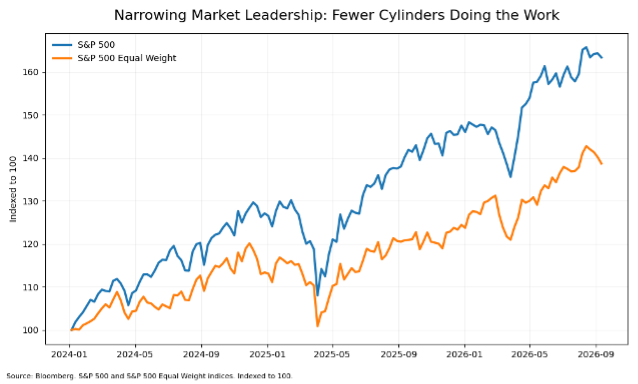
Income distribution matters too. Households most exposed to consumer credit and housing costs feel higher rates before equity indices do; higher-income households with financial assets, by contrast, benefit from strong markets and attractive cash yields.Equity markets mirror this divergence precisely. The S&P 500 rose 2.7% in August, supported by strong earnings and the AI investment cycle. The cap-weighted index nonetheless beat the equal-weighted version once again: a few very powerful cylinders pulled the whole car. On one side, the hyperscalers are ordering data centres, chips and infrastructure; on the other, parts of the retail sector are asking themselves questions about promotions, store footfall and price sensitivity.
Outside the United States, the picture is just as uneven. Japan’s TOPIX gained 3.9% in August and emerging Asia 3.4%, with Taiwan supported by the technology supply chain. Europe advanced less, held back by rising yields and the cost of energy. In China, July’s rebound cooled quickly in the face of fresh signs of weak domestic demand. The common thread is clear: markets reward structural investment and companies able to defend their margins, but they become far less forgiving when growth depends on the consumer’s wallet.
For those running portfolios, the backdrop remains constructive but demands greater selectivity. Earnings growth, capital investment and a solid labour market still justify equity exposure. Higher bond yields and persistent inflation, however, leave less room for a further indiscriminate expansion of multiples. At this stage it is not enough to know that the car is going fast: you need to know which component is supplying the power, and which one is about to need a service.
This document has been prepared by the investment manager of the SICAV, Banor Capital Ltd., a company authorised and regulated by the Financial Conduct Authority (FCA). The content is for information purposes only and does not constitute investment advice, a recommendation, or an offer/solicitation to buy or sell any investment. Views are those of the speaker and may change. Any views expressed regarding future market conditions, sector performance, or investment returns are forward-looking statements and may not materialise. Actual outcomes may differ materially. Forecasts are not a reliable indicator of future performance. This communication is not directed to any person in any jurisdiction where doing so would be unlawful; distribution may be restricted.
Angelo Meda is Head of Equities at Banor SIM S.p.A. and provides research and advisory input to Banor Capital Ltd pursuant to an advisory agreement.
This article is an English translation of an article originally prepared and published by Banor SIM.