
Anthropic Hands AI the Bill
By Angelo Meda, Head of Equities at Banor
The numbers keep growing, but markets have stopped ordering without looking at the prices.
Over the past three years, artificial intelligence has been a dinner party everyone wanted an invitation to. GPUs were ordered like bottles of champagne, data centres like plates of caviar, and investments were signed off with the carefree air of diners convinced that the next table would be picking up the bill. Now, however, the waiter is approaching, and on his tray may well be Anthropic’s listing. The potential IPO of the company behind Claude is far more than the stock-market debut of a new tech champion. It could become the first real public-market test of the economics of large AI models: what they are worth, how much capital they absorb, what profitability they can achieve and, above all, who actually gets to keep the profits generated across the entire value chain.
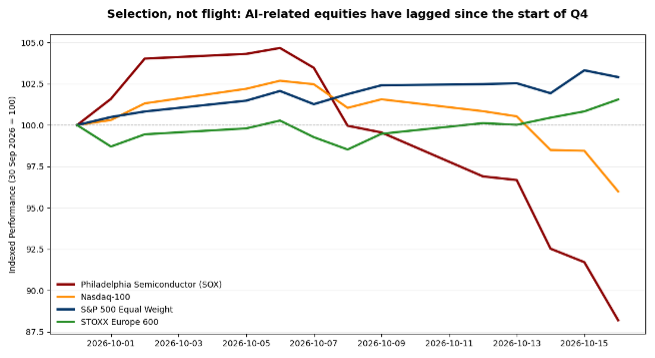
The timing could not be more delicate. In recent weeks, global stock markets have not suffered a genuine broad-based correction, but they have shown a clear crisis of confidence in the most aggressive part of the AI theme. The S&P 500 remains close to its highs, while the Nasdaq and semiconductors have been hit. At the same time, banks, healthcare and many stocks less exposed to technology have proved more resilient.
Anthropic’s Nasdaq listing is tentatively expected in November, at a valuation of close to $2 trillion. The numbers presented to investors are hard to ignore. Third-quarter revenue reportedly reached $16.8 billion, around 45% more than in the previous quarter. The company is also said to have posted its second consecutive quarter of profitability on an adjusted basis, with an adjusted operating margin of close to 11% and roughly $1.70 of revenue for every dollar spent on computing capacity. Extraordinary as it is, however, growth has slowed compared with the leap recorded between the first and second quarters. Some estimates of the annualised revenue run-rate have been scaled back, and investors have begun to ask questions about the sustainability of margins, about competition and about the enormous amount of capital needed to maintain a technological lead. Such is the curious fate of expectations: the higher they climb, the more even excellent results seem to arrive a few minutes late.
The real question is not just how much Anthropic will grow, but what kind of company we are valuing. Unlike a traditional software business, large AI models require chips, energy, networks, data centres and infrastructure contracts on a staggering scale. According to Reuters, Anthropic has long-term commitments of at least $518 billion linked to cloud, computing capacity and infrastructure. The company is therefore part software maker, part digital heavy industry: it sells intelligence, but to produce it, it has to build the technological equivalent of refineries, power stations and motorways.
The relationship with Amazon and Google makes the picture even more interesting. Both are, at one and the same time, investors, infrastructure providers, sales channels, customers and competitors. A very significant share of Anthropic’s 2025 revenue flowed through the two hyperscalers (48%). This relationship can be read as a competitive advantage, because it secures capital, distribution and access to computing capacity, or as a dependency, because a large share of the economic value could be absorbed by the very partners that provide the infrastructure.
The question is therefore very simple to put, but far less simple to answer: who really profits from Anthropic’s growth? Anthropic itself, its chip suppliers, the cloud providers, the data-centre owners or the companies financing the entire build-out? The market has spent several years rewarding almost every participant in the value chain. Now it has started asking to see how the bill is being split.
The listing could have significant consequences even before trading begins. A deal of this size would be unlikely to be funded with fresh cash alone. For many funds, buying Anthropic could turn into a rotation within the technology sector: to make room for the new stock, managers could trim their positions in the most liquid and crowded listed winners, such as Nvidia, Microsoft, Amazon, Alphabet, Meta, Broadcom and Oracle.
This helps to explain some of the recent weakness in AI-related stocks, where the questions being asked are: how much capital will be needed, at what cost and with what return?
The strain is particularly evident among the most heavily indebted companies in the infrastructure supply chain. Fears about the cost of financing data centres and about the ability to keep accessing credit markets have hit names such as CoreWeave and have contributed to the sell-off in semiconductors, hardware and infrastructure suppliers. The fact that the majority of US stocks continued to rise while the Nasdaq fell shows that we are not facing an indiscriminate flight from risk, but an increasingly stringent selection within the AI theme.
Source: Bloomberg; Banor Capital
The market has changed the numbers it considers important. Revenue and orders remain fundamental, but they are now joined by free cash flow, cost of debt, return on invested capital, contract duration and revenue generated per dollar of compute.
The reaction across the different regions also reflects this new sensitivity.
In the United States, the weakness has been concentrated mainly in big tech stocks and the chip supply chain, while financials, healthcare and other sectors have offset part of the losses. In Europe, the STOXX 600 has shown greater stability, helped by solid corporate results and less concentrated exposure to AI, closing out one of its best weeks in recent months at the time of writing.
Asia, by contrast, has seen far more violent swings. Korea, Taiwan and Japan have been directly affected by doubts over technology investment, precisely because a significant part of their respective indices is tied to semiconductors, memory and hardware. Sharp falls were followed by equally rapid rebounds: at times it felt less like a normal trading session than a crash course in cardio for fund managers.
At this stage, it does not seem advisable to abandon the artificial intelligence theme, but it is becoming essential to separate out its different components. It is also important to avoid applying software multiples to businesses whose economics are looking increasingly like those of infrastructure.
Anthropic will therefore be a formidable litmus test. A well-absorbed listing, a valuation close to target and solid trading in the sessions that follow would confirm that the market is still willing to fund AI growth, even when it comes with high capital intensity. A cut in the price, a smaller offering or a postponement, on the other hand, would indicate that a significant gap has opened up between private valuations and those acceptable to public investors.
The waiter has put the bill on the table. Now it remains to be seen who will reach for their credit card, and whether the card terminal will approve the payment.
This document has been prepared by the investment manager of the SICAV, Banor Capital Ltd., a company authorised and regulated by the Financial Conduct Authority (FCA). The content is for information purposes only and does not constitute investment advice, a recommendation, or an offer/solicitation to buy or sell any investment. Views are those of the speaker and may change. Any views expressed regarding future market conditions, sector performance, or investment returns are forward-looking statements and may not materialise. Actual outcomes may differ materially. Forecasts are not a reliable indicator of future performance. This communication is not directed to any person in any jurisdiction where doing so would be unlawful; distribution may be restricted.
Angelo Meda is Head of Equities at Banor SIM S.p.A. and provides research and advisory input to Banor Capital Ltd pursuant to an advisory agreement.
This article is an English translation of an article originally prepared and published by Banor SIM.